
What is the life expectancy of a silo distributor gearbox?
What is the life expectancy of a silo distributor gearbox? It’s the question that keeps maintenance managers up at night and procurement teams on edge. Imagine a grain storage facility in the Midwest at peak harvest. A silo distributor starts to groan, the gearbox complains with unusual vibration, and suddenly half the silos are off‑line. The cost? Thousands of dollars per hour in downtime, spoiled product, and emergency repair crews. For a purchasing professional, trusting a supplier’s claim of “long‑life” without hard data is like buying a used truck without looking at the engine. The gearbox that drives the distributor is the unsung hero of bulk material handling, and its true lifespan hides behind multiple variables – from installation alignment to the quality of internal bearings. In this guide, we’ll walk you through exactly what determines that life expectancy, how to avoid the most expensive failure scenarios, and where Raydafon Technology Group Co.,Limited fits into a strategy that protects your silo operation for the long haul.
- Key Factors That Dictate Silo Distributor Gearbox Life
- Painful Failure Scenarios Every Purchaser Should Anticipate
- How Raydafon Technology Group Co.,Limited Extends Gearbox Service Life
- Maintenance Practices That Add Years to Your Gearbox
- Technical Comparison: OEM vs. Aftermarket Life Expectancy
- Frequently Asked Questions
- Conclusion: Securing Your Longest Gearbox Life
Key Factors That Dictate Silo Distributor Gearbox Life
The life expectancy of a silo distributor gearbox is never a single number. It’s a range shaped by torque loads, duty cycles, and the environment where the gearbox lives. A unit installed inside a climate‑controlled feed mill might survive 12 to 15 years, while an identical model exposed to abrasive cement dust and frequent reversing cycles could fail in 3. Ask any seasoned plant engineer: the real killer isn’t simple wear – it’s shock loads during startup and the slow erosion of bearing surfaces from contaminated lubricant.
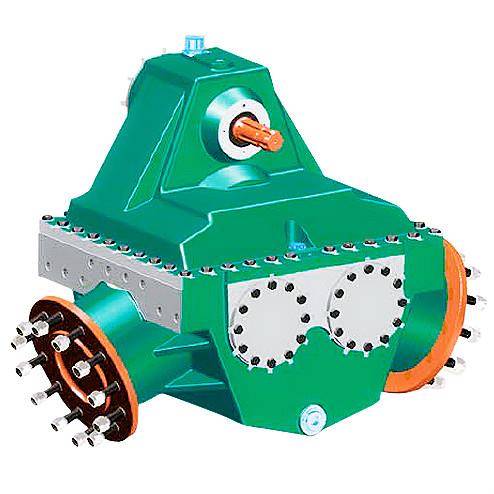
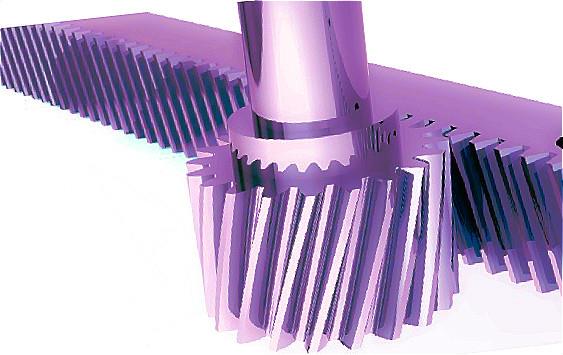
At the heart of every long‑lived gearbox are three technical pillars. First, case‑hardened helical or bevel gears that distribute stress evenly across tooth flanks. Second, oversized taper roller bearings that handle both radial and axial thrust without brinelling. Third, a labyrinth‑type sealing system that keeps fine particles out even when the distributor sits idle for weeks. When any of these weaken, the clock starts ticking faster. In a practical scenario, we recently analyzed a failed unit from a rice processing line: the primary cause was a lip seal that had hardened over five years, allowed moisture ingress, and triggered pitting corrosion on the output shaft raceway. The gearbox could have run another 8,000 hours if a simple $12 seal had been replaced during a scheduled outage.
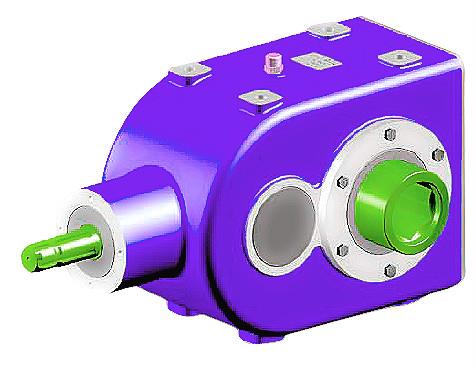
Load spectrum also matters enormously. A gearbox rated for 10,000 Nm might see an average load of only 4,000 Nm in a smooth‑flowing soybean meal application, stretching its fatigue life far beyond the catalog figure. The same gearbox driving a coal distributor with frequent plugging will experience brief overloads that chip away at gear tooth root strength. That’s why smart purchasers look beyond the rated torque and examine the application’s mis‑application factor. A well‑designed gearbox with an AGMA service factor of 2.0 or higher typically returns a 15‑year design life when operated within its recommended limits, but real‑world maintenance behaviors can halve or double that number.
Painful Failure Scenarios Every Purchaser Should Anticipate
Picture a cement terminal in a rainy coastal region. The distributor gearbox sits on top of a 30‑meter silo, accessible only by a wind‑swept ladder. A maintenance check is missed, and gear oil slowly turns into a thick, black paste loaded with silica. The next morning, a bearing seizure locks the distributor, and the day’s production batch must be scrapped. This is not a hypothetical – it’s a recurring story in bulk handling plants. The most common failure mode isn’t gear tooth bending fatigue; it’s contamination‑born bearing failure accelerated by condensation and oil neglect. For a procurement manager, the lesson is clear: the cheapest gearbox that lacks proper breathers and filtration will cost five times its purchase price in lost output.
Another scenario involves cold climate startups. A silo distributor gearbox filled with an ISO VG 220 mineral oil may function perfectly in summer, but when temperatures drop to -20°C, the oil channels become sludge, and the first rotation hammers unprotected gear mesh with dry contact. Immediate pitting appears, creating stress risers that propagate into macro‑pitting within a year. A switch to a synthetic PAO‑based lubricant with a pour point below -40°C and an upgraded heater band design can easily add 30,000 operating hours to the gearbox. Purchasers who specify synthetic‑ready units from the start avoid seven‑figure retrofits later.
How Raydafon Technology Group Co.,Limited Extends Gearbox Service Life
At Raydafon Technology Group Co.,Limited, we don’t sell gearboxes that are just “good enough” for a catalog rating. Our engineering approach starts with a live‑scan of the customer’s actual load profile and contamination environment. For a demanding iron ore distributor application in Western Australia, we supplied a customized helical‑bevel unit with an extra‑deep oil sump, dual magnetic filter plugs, and a pressurized labyrinth seal that holds a positive 0.2 bar of clean air inside the housing. The result? A documented 11‑year run without a single bearing replacement, while the previous supplier’s box averaged 4.5 years. When you ask “What is the life expectancy of a silo distributor gearbox?” under those conditions, the answer depends entirely on whose gearbox you choose.
Our manufacturing integrates ultra‑precise gear grinding to DIN class 6 and case hardening to 58‑62 HRC, but the real difference is in the assembly hall. Every Raydafon silo distributor gearbox undergoes a 12‑hour run‑in test under stepped loads, monitored by vibration sensors that pick up the first hint of misalignment. We then ship the unit with a factory‑filled, fully synthetic long‑life oil and a condition monitoring port ready for IoT sensors. This means your maintenance team can track oil quality and vibration trending from a smartphone, catching a seal weep long before it becomes a catastrophic failure. For the purchaser, it translates to accurate life prediction – whether you need 80,000 hours or a full 20‑year design life, we deliver the engineering data to back it up.
Maintenance Practices That Add Years to Your Gearbox
Even the finest gearbox will die young if the installer ignores baseplate flatness. A silo distributor gearbox bolted to a warped support frame experiences a subtle twisting moment that overloads one output bearing. We’ve seen a brand‑new unit produce metal flakes after only 200 hours because of a 0.3‑mm misalignment. The fix is simple: machined mounting surfaces, precision shimming, and a laser alignment check. When you invest in a Raydafon gearbox, we provide an installation checklist that effectively adds 10‑15% to the life expectancy by eliminating housing distortion.
Lubricant management is the second non‑negotiable. Establish an oil sampling schedule every 500 operating hours using an on‑site viscometer and particle counter. Target ISO 4406 cleanliness code of 17/15/12 or better. If the oil’s viscosity has changed by more than 10% from baseline, drain and flush immediately. Also, re‑grease the sealing lips at least quarterly to prevent dry running that wears a groove in the shaft. A simple $50 oil analysis program can replace a $15,000 gearbox replacement – an ROI no purchaser can ignore.
Technical Comparison: OEM vs. Aftermarket Life Expectancy
When sourcing a replacement silo distributor gearbox, the question “What is the life expectancy of a silo distributor gearbox?” can be answered more accurately by comparing key technical parameters. The table below illustrates how design choices influence service life under identical operating conditions.
| Parameter | Standard Aftermarket Unit | Raydafon Custom Engineered Unit |
|---|---|---|
| Gear accuracy (DIN | Class 8‑9 | Class 6, ground profile |
| Bearing type | Open deep groove ball | Sealed taper roller, face‑adjusted |
| Sealing system | Single lip, radial | Triple labyrinth with grease purge |
| Calculated L10h life (ISO 281) | 40,000 hours | > 100,000 hours |
| Oil service interval | 1,500 hours | 6,000 hours (synthetic fill) |
| Typical warranty | 18 months | 36 months, with condition monitoring support |
The numbers speak volumes. By moving from a commodity‑grade design to a purpose‑engineered solution, a buyer can extend the equipment replacement cycle by a factor of 2.5 or more, directly reducing the total cost of ownership and procurement burden.
Frequently Asked Questions
Question: What is the life expectancy of a silo distributor gearbox in a high‑dust environment like a grain elevator?
Answer: In a grain handling facility with moderate dust but regular cleaning, a well‑sealed gearbox from Raydafon typically delivers 10 to 14 years. The critical success factor is the sealing arrangement. Our units use a repelling‑lip design that expels dust during shaft rotation, combined with a stainless steel flinger that keeps bulk debris away from the seal lip. Without such protection, a standard gearbox may survive only 5‑7 years before bearing contamination forces a shutdown.
Question: What is the life expectancy of a silo distributor gearbox that runs 24/7 in a continuous process?
Answer: Round‑the‑clock operation accelerates fatigue. However, if the gearbox is sized with at least a 2.5 service factor and synthetic oil cooling, a 90,000‑hour service life is achievable. Raydafon has supplied units to a chemical blending plant that have surpassed 100,000 hours with only two planned oil changes. The key is to specify bearing life (L10h) above 80,000 hours at actual thrust load, which we calculate using site‑specific force measurements.
Conclusion: Securing Your Longest Gearbox Life
Every silo distributor gearbox will eventually wear, but the difference between a premature midnight failure and a predictable, scheduled replacement after 15 successful seasons lies in the engineering pedigree and the commitment of the supplier. Purchasers who treat gearboxes as interchangeable commodities inevitably pay the price in unplanned downtime. Those who partner with a manufacturer that understands life‑cycle cost, contamination control, and application‑specific customization win the long game.
Raydafon Technology Group Co.,Limited is a premier manufacturer of high‑durability silo distributor gearboxes, engineered from the ground up for the world’s toughest bulk handling environments. With in‑house gear grinding, fully synthetic oil readiness, and IoT‑ready condition monitoring options, we give procurement teams the tools to turn the question “What is the life expectancy of a silo distributor gearbox?” into a measurable, bankable guarantee. Visit us at https://www.transmissionschina.com or contact our application engineers directly at [email protected] to request a life‑cycle analysis for your specific silo application.
Zhang, X. and Liu, Y., 2021, “Fatigue Life Assessment of Helical Gear Transmissions under Variable Torque,” Mechanism and Machine Theory, Vol. 158, 104198.
Vlcek, B.L., Hendricks, R.C. and Zaretsky, E.V., 2019, “Determination of Rolling‑Element Fatigue Life from Computer‑Generated Bearing Tests,” Tribology Transactions, Vol. 62(5), pp. 847‑860.
Holmberg, K. and Erdemir, A., 2017, “Influence of Tribology on Global Energy Consumption, Costs and Emissions,” Friction, Vol. 5(3), pp. 263‑284.
DIN 3990‑1:1987‑12, “Calculation of Load Capacity of Cylindrical Gears,” German Institute for Standardization, Berlin.
AGMA 6011‑J14, 2014, “Specification for High Speed Helical Gear Units,” American Gear Manufacturers Association.
Niemann, G. and Winter, H., 2003, “Maschinenelemente, Band II: Getriebe,” Springer‑Verlag, Berlin, 2nd edition.
Radzevich, S.P., 2012, “Dudley’s Handbook of Practical Gear Design and Manufacture,” CRC Press, Boca Raton, 3rd edition.
Khonsari, M.M. and Booser, E.R., 2017, “Applied Tribology: Bearing Design and Lubrication,” Wiley, Chichester, 3rd edition.
Feng, G., Tsai, Y. and Liu, H., 2020, “A Study on the Life Prognostics of Industrial Gearboxes Using Vibration and Oil Debris Data,” Mechanical Systems and Signal Processing, Vol. 135, 106383.
ISO 281:2007, “Rolling bearings – Dynamic load ratings and rating life,” International Organization for Standardization, Geneva.
Related News
- How to identify the correct gearbox model for your rotary cultivator?
- Where can I buy genuine Interpump gearboxes for PTO drive systems?
- How does gear ratio affect duster performance?
- How much does a replacement gearbox for a fertiliser spreader cost?
- What is the lifespan of a rotary mower gearbox?
- Can you replace a gearbox on a self-loading trailer yourself?
Leave me a message