- Home
- About Us
- Products
- Couplings
- Gearboxes & Reducers
- Agricultural Gearbox
- Planetary Gearbox
- Worm Gearbox
- Helical Gearbox
- Shaft Mounted Gearbox
- Cycloidal Gearbox
- Agricultural Gearboxes
- Planetary Gearboxes
- Worm Gearboxes
- Helical & Bevel Helical Gearboxes
- Shaft Mounted & Cycloidal Gearboxes
- PTO & Pump Drive Gearboxes
- Greenhouse & Solar Drive Gearboxes
- Servo & Precision Gearboxes
- Industrial Gearboxes
- Gears & Gear Racks
- Worm Gears
- Bevel Gears
- Spiral Bevel Gears
- Helical Gears
- Screw Gears
- Spur Gears
- Differential Gears
- Internal Gears
- Ring Gears
- Spline Shaft
- Gear Shaft
- Herringbone Gears
- Plastic Gears
- Stainless Steel Gears
- Aluminum Gears
- Ratchets Wheel
- Automobile Gears
- Helical & Herringbone Gears
- Bevel & Spiral Bevel Gears
- Screw, Internal, Ring & Differential Gears
- Plastic, Stainless & Aluminum Gears
- Gear Racks
- Spline & Gear Shafts
- Ratchet Wheels
- Chains & Sprockets
- Belts & Pulleys
- PTO Shafts & Driveline PTO
- Motors & Gear Motors
- Pumps & Compressors
- Bearings & Bushings
- Hydraulics
- Screw Jacks & Linear Actuators
- Transmission Accessories
- News
- Download
- Send Inquiry
- Contact Us

Screw Gears
High-Quality Screw Gears for Precision Applications
Screw gears are essential components in various mechanical systems where power transmission between non-parallel, non-intersecting shafts is required. Our premium screw gears offer superior performance, durability, and efficiency for demanding industrial applications.
Key Features of Our Screw Gears
- Manufactured from high-grade alloy steel for exceptional strength
- Precision ground tooth profiles for smooth operation
- Surface hardened to RC 58-62 for extended service life
- Available in various pressure angles (14.5°, 20°, 25°)
- Customizable helix angles to meet specific application requirements
Technical Specifications
| Parameter | Range | Tolerance |
|---|---|---|
| Module Range | 1.0 - 12.0 | ±0.01mm |
| Outer Diameter | 20mm - 500mm | ±0.05mm |
| Face Width | 10mm - 150mm | ±0.02mm |
| Gear Ratio | 1:1 - 5:1 | N/A |
| Maximum RPM | Up to 3000 | N/A |
Screw Gears FAQ
What are the primary applications of screw gears?
Screw gears are commonly used in conveyor systems, packaging machinery, printing presses, and various industrial automation equipment where high torque transmission at right angles is required. They excel in applications needing precise positioning and smooth motion transfer between non-intersecting shafts.
How do I determine the correct lubrication for screw gears?
The lubrication requirements depend on operating speed, load, and environmental conditions. For moderate speeds (below 1000 RPM), use EP gear oil with ISO viscosity grade 150-320. High-speed applications require synthetic lubricants with superior thermal stability. Always consult our technical datasheets for specific recommendations based on your operating conditions.
Material Options
| Material Type | Hardness | Application |
|---|---|---|
| SCM440 | HRC 58-62 | High-load industrial applications |
| S45C | HRC 50-55 | General purpose machinery |
| Stainless Steel | HRC 40-45 | Food processing & corrosive environments |
Installation Guidelines
- Ensure proper shaft alignment within 0.05mm tolerance
- Apply recommended lubricant before initial operation
- Check backlash (0.05-0.15mm typically recommended)
- Perform initial run-in at reduced load (30% capacity for first 8 hours)
- Monitor temperature during initial operation (should not exceed 80°C)
More Screw Gears Questions
What maintenance schedule should be followed for screw gears?
Regular maintenance includes lubricant inspection every 250 operating hours, complete lubricant change every 2000 hours, and thorough inspection of tooth wear every 5000 hours. In harsh environments, these intervals should be reduced by 30-50%. Always check for abnormal noise, vibration, or temperature rise during routine inspections.
Customization Options
We offer various customization options to meet your specific requirements:
- Special tooth profiles (modified involute, cycloidal)
- Non-standard bore sizes with keyways or splines
- Special surface treatments (black oxide, nickel plating)
- Custom gear ratios outside standard ranges
- Special packaging for export requirements
Screw Gears Technical Questions
How do I calculate the efficiency of screw gears?
Screw gear efficiency depends on the helix angle, gear ratio, and friction coefficient. Typical efficiency ranges from 70-95%. The formula is: Efficiency (%) = [cos(β) - μ tan(λ)] / [cos(β) + μ cot(λ)] × 100, where β is the pressure angle, μ is the friction coefficient (0.05-0.15 for well-lubricated steel), and λ is the lead angle. Our engineers can provide precise calculations for your specific application parameters.
Quality Assurance
All our screw gears undergo rigorous quality control procedures:
- 100% dimensional inspection using CMM
- Surface hardness testing on every batch
- Run-in testing for noise and vibration levels
- Material certification from approved mills
- Traceability maintained throughout production
- View as
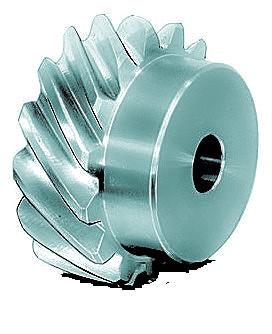
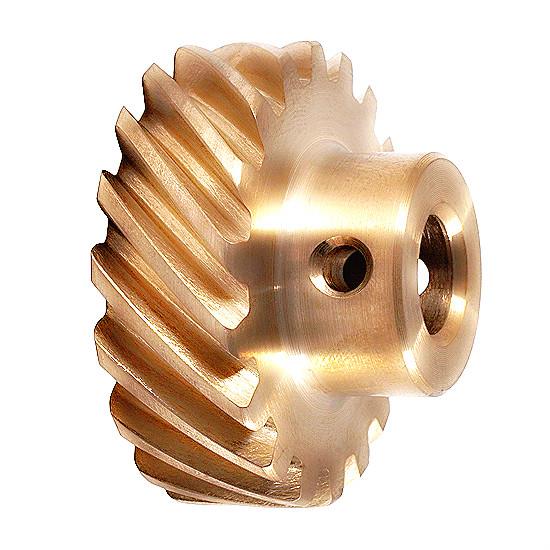
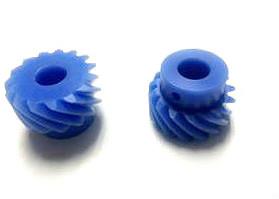
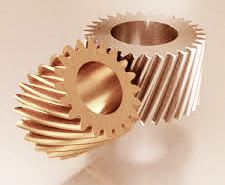
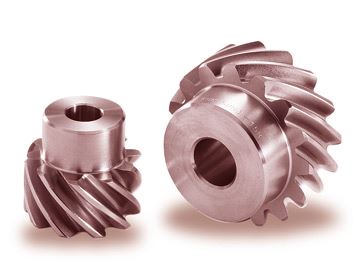
Bronze Screw Gears
Aluminum-Bronze Screw Gears Specifications Precision grade JIS grade N9 (JIS B1702-1: 1998) JIS grade 5 (JIS B1702: 1976) Reference section of gear Aluminum-Bronze Screw Gears Normal plane Gear teeth Standard complete depth Normal pressure angle 20° Helix angle 45° Material CAC702 ① When mating...
Stainless Steel Screw Gears
Our metric screw gears come in stainless steel, mild steel, aluminum bronze or plastic materials. Screw gears are available in M1 to M4 module sizes. Click any of the screw gear images to view full product details. Raydafon manufactures fine pitch gearing solutions for a variety of industries...