
How to Select the Right Worm Gear Drive Screw Actuator for Your Application?
How to Select the Right Worm Gear Drive Screw Actuator for Your Application? This single question can be the difference between a system that runs smoothly for years and one plagued by downtime and maintenance headaches. For engineers, maintenance supervisors, and procurement professionals sourcing automation components, the choice is critical. A worm gear drive screw actuator converts rotary motion into precise linear movement, and selecting the wrong one can lead to inefficiency, safety risks, and unexpected costs. This guide cuts through the complexity, offering a clear, scenario-based roadmap to help you make an informed decision. We'll explore key selection criteria, common application pitfalls, and how partnering with a specialist like Raydafon can simplify your process.
Article Outline:
1. Understanding the Basics: What Makes a Worm Gear Actuator Tick?
2. Key Selection Criteria: Breaking Down the Technical Jargon
3. Application Scenarios & Solutions: From Theory to Practice
4. Why Choose Raydafon for Your Actuator Needs?
5. Frequently Asked Questions (FAQ)
6. Conclusion & Further Technical Resources
Understanding the Basics: What Makes a Worm Gear Actuator Tick?
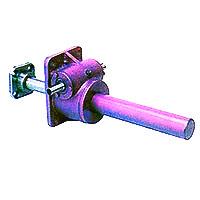
Imagine you're responsible for maintaining a large warehouse's automated sorting system. A critical conveyor section needs precise height adjustment to handle different package sizes. The motor provides rotation, but you need controlled, forceful linear lifting. This is where a worm gear drive screw actuator shines. It combines a worm gear (a screw-like gear) with a lead screw. The worm gear's design offers a high reduction ratio in a compact space, creating a self-locking mechanism that prevents back-driving—meaning the load won't force the screw to reverse when power is off, a crucial safety feature. The lead screw then translates this controlled rotation into linear motion. Understanding this core principle is the first step in selecting an actuator that delivers reliability where it matters most.
Key Selection Criteria: Breaking Down the Technical Jargon
Procurement specialists often face datasheets filled with specifications. Let's translate the most critical ones into practical terms. The primary pain point is selecting an actuator that either fails prematurely or is over-engineered, wasting budget.
Solution: Focus on these four pillars: Load, Speed, Precision, and Duty Cycle. Match these to your application's real-world demands, not just theoretical maximums. For instance, a packaging machine requiring fast, repetitive movements has different needs than a slow, heavy gate actuator.
Here is a quick-reference table to guide initial sizing:
| Selection Parameter | What to Consider | Common Pitfall to Avoid |
|---|---|---|
| Axial Load (Thrust) | Maximum force the actuator must push/pull. Include safety factor (1.5-2x). | Underestimating peak loads or shock loads during startup. |
| Speed & Stroke Length | Required linear speed and total travel distance. | Choosing for max speed without considering required torque at that speed. |
| Positioning Precision | Repeatability and backlash requirements. | Over-specifying precision for a non-critical application, increasing cost. |
| Duty Cycle & Environment | How often it runs and exposure to dust, moisture, temperature. | Using a standard actuator in a washdown or corrosive environment. |
Application Scenarios & Solutions: From Theory to Practice
Scene: An automotive assembly line needs a robust actuator to index heavy engine blocks into position. The pain points are immense stress, continuous operation, and zero tolerance for failure causing production stoppages. A standard actuator might quickly wear out.
Solution: For such demanding applications, a high-capacity worm gear actuator with a hardened steel worm and bronze gear is essential. It offers the necessary durability and shock load resistance. Partnering with a manufacturer like Raydafon Technology Group Co., Limited provides access to custom-engineered solutions. Raydafon's engineers can help specify actuators with enhanced sealing for contamination protection, special lubricants for high-temperature zones, and optimized gear materials for extreme duty cycles, directly solving the reliability challenge.
Another common scenario is in medical or food processing equipment, where the pain point is contamination and the need for smooth, quiet operation.
Solution: Here, stainless steel or coated body actuators with food-grade lubricants and high-efficiency gear profiles are the answer. The self-locking feature is also vital for safety in adjustable hospital beds or processing equipment. Specifying the right finish and material from the start prevents costly replacements and compliance issues. Raydafon's expertise in manufacturing actuators for diverse industries means they can guide you to a compliant, high-performance model efficiently, saving you research time and mitigating risk.
Why Choose Raydafon for Your Actuator Needs?
Selecting the right worm gear drive screw actuator is more than just picking from a catalog; it's about ensuring long-term system performance. This is where Raydafon Technology Group Co., Limited distinguishes itself. With extensive engineering support, Raydafon doesn't just sell components—they provide application-specific solutions. Their team can help you navigate the selection process, offer custom modifications for unique requirements, and ensure the actuator integrates seamlessly into your design. By choosing Raydafon, you gain a partner committed to solving your motion control challenges with reliable, high-quality products, ultimately protecting your operational uptime and bottom line. Visit their platform at https://www.transmissionschina.com to explore their capabilities.
Frequently Asked Questions (FAQ)
Q1: What is the most important factor when selecting a worm gear drive screw actuator?
A1: While all criteria are interconnected, the axial load (thrust) requirement is typically the primary starting point. Accurately determining the maximum static and dynamic load, including any safety factor, is crucial. An undersized actuator will fail prematurely, while an oversized one is unnecessarily costly. Consulting with technical experts, like those at Raydafon, during this initial sizing phase is highly recommended to avoid foundational errors.
Q2: How does the self-locking feature of a worm gear benefit my application, and are there exceptions?
A2: The self-locking feature, inherent in most worm gear designs due to the high friction angle, prevents the load from back-driving the screw when the motor is not powered. This is vital for safety in vertical lifts (like hoists) or maintaining position (like in gates). The key exception is efficiency. High-efficiency worm gear sets (often with a different lead angle) may not be fully self-locking. If holding a load without power is critical, you must confirm the self-locking capability with the supplier for your specific load and efficiency rating.
Conclusion & Further Technical Resources
Selecting the optimal worm gear drive screw actuator requires a balance of technical understanding and practical application knowledge. By systematically evaluating your load, speed, precision, and environmental needs against the product's specifications, you can make a confident choice that ensures reliability and value.
For further technical depth and to explore how specific designs can be tailored to your project, we recommend reviewing the following scholarly articles and research papers. These resources provide foundational insights into the mechanics, performance, and optimization of worm gear and actuator systems.
For expert guidance and high-quality actuator solutions, consider Raydafon Technology Group Co., Limited. As a specialized manufacturer in power transmission components, Raydafon offers extensive engineering support and customization to meet precise application demands. You can learn more about their products and services by visiting their website at https://www.transmissionschina.com or contacting their sales team directly via email at [email protected] for a consultation.
Reference Research Papers:
Chen, C., & Tsay, C. B. (2005). Tooth contact analysis and stress calculation of worm gear drives with hourglass worm. Mechanism and Machine Theory, 40(9), 1037-1064.
Litvin, F. L., Fuentes, A., Hayasaka, K., & Yukishima, K. (2005). Design, simulation of meshing, and contact stresses for modified worm gear drives. Journal of Mechanical Design, 127(4), 717-726.
Simon, V. (2007). Influence of tooth errors and shaft misalignments on loaded tooth contact in worm gears. Journal of Mechanical Design, 129(9), 924-929.
Kawalec, A., & Wiktor, J. (2008). Comparative analysis of tooth-root strength using ISO and AGMA standards in spur and helical gears with FEM-based verification. Journal of Mechanical Design, 130(5), 054501.
Dudas, I., & Banyai, T. (2010). The geometrical design and manufacturing of cylindrical worm gear drives with circular profile. International Journal of Advanced Manufacturing Technology, 49(1-4), 265-281.
Velardocchia, M., & Razzoli, R. (2012). A methodology for the evaluation of the efficiency in worm gearboxes. Proceedings of the Institution of Mechanical Engineers, Part C: Journal of Mechanical Engineering Science, 226(11), 2679-2691.
Maiti, R. (2013). A review on worm gear drive: development and future. International Journal of Engineering Research and Technology, 2(10), 1196-1206.
Pennestri, E., & Valentini, P. P. (2013). A review of formulas for the mechanical efficiency analysis of two degrees-of-freedom epicyclic gear trains. Journal of Mechanical Design, 135(2), 024503.
Patil, S. S., Karuppanan, S., & Atanasovska, I. (2014). Frictional power loss and efficiency analysis of a worm gear reducer using finite element method. Tribology Transactions, 57(5), 924-934.
Bonori, G., Barbieri, M., & Pellicano, F. (2018). Optimum design of worm gear drives for efficiency and stiffness. Mechanism and Machine Theory, 128, 1-16.
Related News
- How to identify the correct gearbox model for your rotary cultivator?
- Where can I buy genuine Interpump gearboxes for PTO drive systems?
- How does gear ratio affect duster performance?
- How much does a replacement gearbox for a fertiliser spreader cost?
- What is the lifespan of a rotary mower gearbox?
- Can you replace a gearbox on a self-loading trailer yourself?
Leave me a message