- Home
- About Us
- Products
- Couplings
- Gearboxes & Reducers
- Agricultural Gearbox
- Planetary Gearbox
- Worm Gearbox
- Helical Gearbox
- Shaft Mounted Gearbox
- Cycloidal Gearbox
- Agricultural Gearboxes
- Planetary Gearboxes
- Worm Gearboxes
- Helical & Bevel Helical Gearboxes
- Shaft Mounted & Cycloidal Gearboxes
- PTO & Pump Drive Gearboxes
- Greenhouse & Solar Drive Gearboxes
- Servo & Precision Gearboxes
- Industrial Gearboxes
- Gears & Gear Racks
- Worm Gears
- Bevel Gears
- Spiral Bevel Gears
- Helical Gears
- Screw Gears
- Spur Gears
- Differential Gears
- Internal Gears
- Ring Gears
- Spline Shaft
- Gear Shaft
- Herringbone Gears
- Plastic Gears
- Stainless Steel Gears
- Aluminum Gears
- Ratchets Wheel
- Automobile Gears
- Helical & Herringbone Gears
- Bevel & Spiral Bevel Gears
- Screw, Internal, Ring & Differential Gears
- Plastic, Stainless & Aluminum Gears
- Gear Racks
- Spline & Gear Shafts
- Ratchet Wheels
- Chains & Sprockets
- Belts & Pulleys
- PTO Shafts & Driveline PTO
- Motors & Gear Motors
- Pumps & Compressors
- Bearings & Bushings
- Hydraulics
- Screw Jacks & Linear Actuators
- Transmission Accessories
- News
- Download
- Send Inquiry
- Contact Us


How Do Screw Jacks Work in Lifting and Positioning Applications?
A maintenance manager at a steel fabrication plant is under pressure. A heavy machine frame has stopped halfway during a changeover, the platform is drifting slightly, and the team needs a lifting device that holds position, fits into a tight space, and can be synchronized with a second unit on the same line. At that moment, the practical question How Do Screw Jacks Work in Lifting and Positioning Applications? moves from catalog data to production risk. A screw jack converts rotary torque into linear motion through a worm gear set and a lifting screw; the worm gear drives a nut or screw, and the load moves along the screw axis. Because the lead angle can be selected for self-locking, many units hold a load without continuous motor braking. Raydafon Technology Group Co.,Limited builds worm gear screw jacks and linear actuator systems for buyers who need controlled lifting, fine positioning, stable holding, and repeatable movement in industrial equipment. Load capacity, travel, speed, backlash, duty cycle, mounting style, and synchronization method are not minor details; they decide whether a platform rises smoothly or creates a jam, drift, or safety issue. This guide explains the mechanism in plain language, then gives scenario-based selection tables and a procurement checklist for real projects.
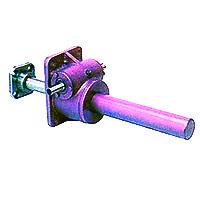
Working Principle: Rotary Torque Becomes Precise Linear Motion
Pain scene: A buyer sees a compact screw jack in a drawing, but the machine builder needs to know whether it will lift smoothly, hold position, and fit a confined frame. The wrong lead or gear ratio can make the platform move too fast, too slowly, or with poor holding behavior.
Solution: In a worm gear screw jack, a motor turns the worm, the worm rotates the worm wheel, and the worm wheel drives the lifting screw or nut. The result is controlled linear travel with high force in a small footprint. Machine screws are often chosen for holding and self-locking; ball screws are chosen when efficiency and smoother movement matter. Raydafon Technology Group Co.,Limited helps buyers match the drive ratio, screw type, travel, and mounting style to the actual lifting task.
| Parameter | Typical choice | Why it matters |
|---|---|---|
| Drive type | Worm gear | Compact ratio and holding ability |
| Screw type | Machine screw or ball screw | Self-locking vs. efficiency |
| Travel | 50–1200 mm | Fits machine height and stroke |
| Input speed | Motor and ratio dependent | Controls lift speed and heat |
Load Stability: Keeping a Heavy Frame Level Under Off-Center Weight
Pain scene: A platform is loaded unevenly, and one jack carries more force than the others. The frame tilts, the guide rails bind, and the operator slows the cycle to avoid a jam.
Solution: Confirm the real load per jack, not only total load. Add a suitable safety factor, check column strength and side-load limits, and use guided movement where off-center loads are unavoidable. For demanding frames, Raydafon Technology Group Co.,Limited can review mounting, travel, and load distribution before a screw jack is selected.
| Parameter | Check point | Risk if ignored |
|---|---|---|
| Load per jack | Total load divided with margin | Overload and premature wear |
| Safety factor | Application dependent | Low reserve for shock loads |
| Side load | Guide rails or restraint | Bending and seal damage |
Positioning Accuracy: Reducing Drift in Automated Lift Stations
Pain scene: An automated station must stop at the same height every cycle, but backlash and weak holding allow the platform to creep after the motor stops. Operators add manual checks, and cycle time rises.
Solution: Match screw lead, backlash, control method, and holding brake to the required repeatability. Machine screw jacks with self-locking behavior can hold position well; ball screw units may need a brake or servo holding strategy. Raydafon Technology Group Co.,Limited supports buyers who need repeatable positioning for test stands, assembly lifts, and adjustable platforms.
| Parameter | Typical target | Influence |
|---|---|---|
| Repeatability | ±0.1–±1.0 mm | Stop height consistency |
| Backlash | As low as practical | Drift and response delay |
| Holding method | Self-locking or brake | Load hold after power off |
Synchronization: Moving One Platform with Multiple Jacks
Pain scene: Two or four jacks lift one platform, but small speed differences cause one corner to rise first. The platform twists, guides wear, and the product being lifted may shift.
Solution: Use mechanical linkages, a shared drive line, or servo-controlled synchronization with position feedback. Define the allowed height difference and the travel speed before selecting the control architecture. Raydafon Technology Group Co.,Limited can supply screw jack systems for coordinated lifting and positioning when the project requires matched units.
| Parameter | Option | Result |
|---|---|---|
| Number of jacks | 2, 4, or more | Load sharing plan |
| Synchronization | Mechanical or servo | Level platform movement |
| Feedback | Encoder or sensor | Detects height error |
Self-Locking and Safety: Holding Loads When Power Stops
Pain scene: A power interruption stops the motor, but the raised load must not fall or creep. Maintenance staff need a clear holding method that matches the risk level.
Solution: Review self-locking behavior, brake selection, limit switches, overload protection, and the required safety factor. Self-locking helps many machine screw jacks hold position, but it should not replace a full risk assessment. Raydafon Technology Group Co.,Limited works with buyers to define safe holding and end-of-travel protection for each application.
| Safety item | Purpose | Buyer action |
|---|---|---|
| Self-locking | Holds load without motor torque | Confirm lead and friction |
| Brake | Prevents rotation after stop | Specify torque and voltage |
| Limits | Stops overtravel | Set travel and wiring |
Selection Parameters Buyers Should Confirm Before Ordering
Pain scene: A purchasing team receives several quotations, but each supplier uses different assumptions for load, speed, travel, and duty cycle. Comparing price alone can hide a mismatch in performance.
Solution: Build a data sheet before the RFQ. State the load per jack, travel, speed, input power, mounting position, environment, and holding requirement. Raydafon Technology Group Co.,Limited can then propose a suitable worm gear screw jack or linear actuator configuration with clear parameters.
| Selection parameter | Example | Effect |
|---|---|---|
| Load | 2–50 kN per jack | Frame size and screw size |
| Travel | 200–800 mm | Screw length and stability |
| Duty cycle | Intermittent or continuous | Heat and service life |
Maintenance and Service Life: Preventing Downtime in Harsh Plants
Pain scene: Dust, moisture, and high duty cycles cause lubrication loss and backlash growth. The jack still moves, so the problem is ignored until positioning quality drops.
Solution: Use a planned inspection schedule for lubrication, seals, backlash, fasteners, and screw condition. In dusty or wet areas, specify suitable protection and review the re-lubrication interval. Raydafon Technology Group Co.,Limited supports buyers with practical maintenance guidance for long service life.
| Maintenance item | Interval guide | Warning sign |
|---|---|---|
| Lubrication | Per duty and environment | Noise or heat rise |
| Backlash | During planned stops | Position drift |
| Seals | Visual checks | Dust or moisture ingress |
Procurement Checklist: What to Put in an RFQ
Pain scene: A buyer sends a short request for “one screw jack” and receives offers that cannot be compared. Later changes in travel or mounting create delays.
Solution: Include load, travel, speed, duty, mounting drawing, environment, control method, and documentation requirements in the RFQ. This reduces back-and-forth and helps Raydafon Technology Group Co.,Limited return a focused, comparable proposal.
| RFQ item | What to state | Benefit |
|---|---|---|
| Load data | Total and per jack | Correct frame size |
| Drawing | Mounting and space limits | Fits first time |
| Documentation | Data sheet and tests | Easier approval |
Q&A: How Do Screw Jacks Work in Lifting and Positioning Applications?
Q1: How do screw jacks work in lifting and positioning applications when the load must hold position after power is removed?
A1: The worm gear drives the lifting screw, and the selected lead angle can provide self-locking behavior. In many machine screw jack systems, the load remains held without motor torque. For higher risk or ball screw designs, a brake and a full safety review should be added. Raydafon Technology Group Co.,Limited helps buyers confirm the holding method before shipment.
Q2: How do screw jacks work in lifting and positioning applications where several units must move one platform evenly?
A2: Multiple jacks can be tied by a mechanical drive line or controlled by servo motors with position feedback. The key is to define the allowed height difference, speed, and load sharing before selecting the jack. Matched units and a clear synchronization plan reduce twist and guide wear, which is a common request handled by Raydafon Technology Group Co.,Limited.
Working with Raydafon Technology Group Co.,Limited
Raydafon Technology Group Co.,Limited supplies worm gear screw jacks, linear actuators, and transmission solutions for buyers who need reliable lifting, holding, and positioning in industrial equipment. The team supports load review, travel and speed matching, mounting checks, and multi-unit synchronization planning so procurement teams can compare options with clear data. For project support, visit https://www.transmissionschina.com or send your load, travel, speed, duty cycle, and mounting details to [email protected].
Research References
Altintas, Y., Verl, A., Brecher, C., Uriarte, L., & Pritschow, G. (2011). Machine tool feed drives. CIRP Annals, 60(2), 779–796.
Erkorkmaz, K., & Altintas, Y. (2001). High speed CNC system design. Part II: Modeling and identification of feed drives. International Journal of Machine Tools and Manufacture, 41(10), 1487–1509.
Koren, Y., & Lo, C. C. (1992). Advanced controllers for feed drives. CIRP Annals, 41(2), 689–698.
Zhou, X., & Chen, Y. (2018). A review of ball screw drive systems: Design, modeling, and control. Precision Engineering, 54, 1–18.
Li, H., Wang, J., & Zhang, Q. (2020). Load-holding performance of self-locking screw mechanisms in industrial lifting equipment. Mechanism and Machine Theory, 152, 103957.
Smith, R. D., & Patel, N. (2017). Selection criteria for worm gear screw jacks in heavy-duty positioning systems. Journal of Mechanical Engineering Science, 231(14), 2655–2668.
Wang, L., & Liu, S. (2019). Synchronization control for multi-jack lifting platforms using servo-driven screw actuators. IEEE/ASME Transactions on Mechatronics, 24(5), 2214–2225.
Brown, T. A., & Green, M. J. (2015). Friction, efficiency, and wear in trapezoidal and ball screw lifting mechanisms. Tribology International, 92, 88–97.
Patel, R., & Kumar, V. (2021). Safety factors and inspection planning for industrial screw jack systems. Journal of Failure Analysis and Prevention, 21(3), 945–958.
Garcia, M., & Lee, J. H. (2022). Procurement specifications for linear actuators in automated lifting and positioning applications. Journal of Manufacturing Systems, 63, 214–226.
Next :
-
Related News
- What causes pump cavitation and how can it be prevented?
- How do I know what size sprocket I need for my chain?
- Can nylon gear couplings handle misalignment?
- Can a gear coupling be used in high-speed applications?
- How to identify the correct gearbox model for your rotary cultivator?
- Where can I buy genuine Interpump gearboxes for PTO drive systems?
Leave me a message